
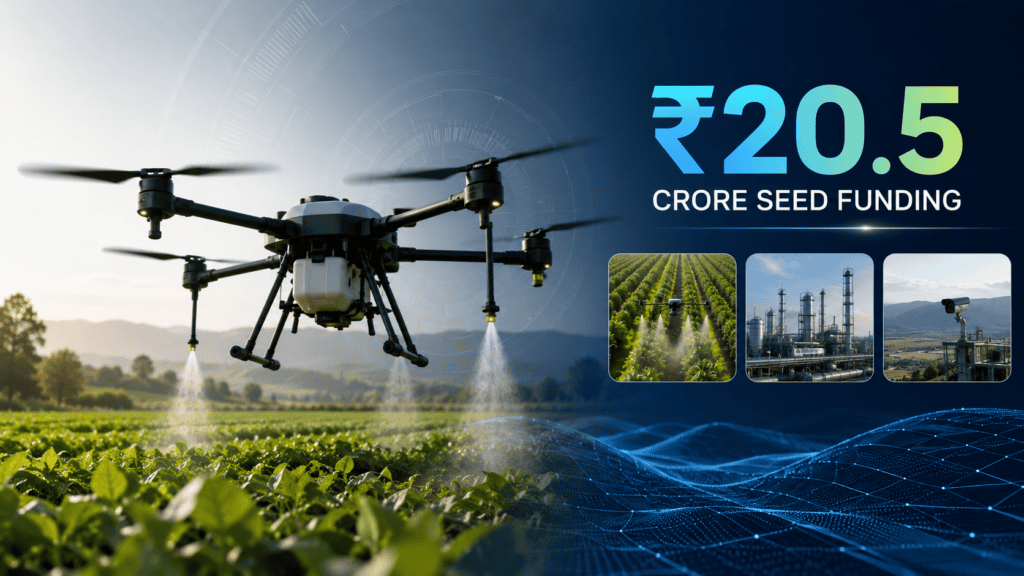
Bengaluru based robotics company SUIND has raised INR 20.5 crore in a seed funding round led by Transition VC, with participation from IIMA Ventures. The company builds autonomous drone systems that can operate without relying on GPS, a capability it says is critical for real world environments such as farms, plantations, and industrial sites where satellite signals are often weak or unavailable.
According to the company, most drones today depend on GPS for navigation, which works well at high altitudes and in open skies. However, this reliance becomes a major limitation when drones need to fly close to the ground, near obstacles, under tree canopies, or in terrain where GPS signals degrade or disappear altogether. SUIND believes this is precisely the gap it is trying to close, since most real world settings such as farmland, orchards, infrastructure sites, and defence terrain are rarely flat or GPS friendly.
At the center of SUIND’s offering is Bumblebee, a DGCA type certified autonomous spraying drone built on the company’s vision based autonomy stack. Instead of depending on GPS, Bumblebee uses visual perception to understand its surroundings, identify terrain features and obstacles in real time, and make navigation decisions independently, similar to how a human pilot would operate a aircraft, but without the associated risks to human safety.
The company stated that Bumblebee has already been deployed in the field across crops including sugarcane, rubber, and banana plantations. Farmers using the platform have reportedly seen improvements in spraying consistency, along with reductions in water usage, chemical consumption, operating costs, and direct human exposure to agrochemicals during spraying operations.
With the new capital, SUIND has outlined three main priorities. The first is scaling up commercial deployment and manufacturing of the Bumblebee platform, with the goal of making autonomous spraying accessible to a larger number of farmers and agricultural service providers across India.
The second priority is accelerating development of a new platform called WASP, described as an aerial intelligence and inspection system. WASP is being designed for use cases beyond agriculture, including infrastructure inspection, industrial monitoring, and security and surveillance applications.
The third focus area is continuing to strengthen the underlying autonomy technology itself. SUIND has emphasized that its long term goal is not simply building more drone hardware, but advancing the intelligence layer that allows aerial systems to operate safely and reliably in complex, real world conditions where GPS alone is not sufficient.
The company has expressed a broader belief that drones should evolve beyond being remotely piloted flying machines and instead become intelligent robotic workers capable of understanding and navigating real world environments on their own. This includes operating close to the ground, around physical obstacles, and in conditions where traditional navigation systems fall short.
With this funding round, SUIND is positioning itself to expand its footprint in the agricultural drone space while simultaneously building out new applications for its autonomy technology through the upcoming WASP platform. The company’s approach centers on solving navigation challenges in environments that have historically been difficult for drones to operate in safely and consistently.
As the demand for automation in agriculture and industrial monitoring continues to grow in India, SUIND’s focus on GPS independent navigation could position it as a notable player in the country’s expanding drone technology ecosystem.